Timber yard in Anno 1800 is one of the very first production chains you’ll build, and it’s absolutely essential for early expansion. It starts with wood from Lumberjack Huts, which is then processed into timber at Sawmills. Timber is required for nearly every construction project in the early game, making it a cornerstone of your economy. Below is a step‑by‑step guide to building this chain so it runs smoothly and efficiently.
What is produced
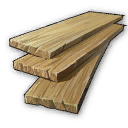
In Anno 1800, timber is one of the most important materials. First, you need it to build your very first structures. Next, as your city expands, timber remains essential because every new building requires it. Moreover, it continues to play a role in nearly every stage of development. Finally, managing timber well is the key to steady growth throughout the game.
Buildings in this chain
In Anno 1800, timber production begins with two essential buildings: the Lumberjack’s Hut and the Sawmill. First, the Lumberjack’s Hut gathers wood from nearby forests, ensuring a steady supply of wood. Then, those logs are transported to the Sawmill, where they are processed into timber. As a result, timber quickly becomes the backbone of construction, since almost every building requires it.
Moreover, when you manage both Lumberjack huts and sawmills together, you create a reliable production chain. As a result, this chain supports your city’s growth from the very first houses all the way to advanced developments. In addition, timber production provides stability and long term expansion. Finally, this makes timber one of the most important resources in the game.
| Building | No. of buildings needed | Total cost |
|---|---|---|
| Lumberjacks hut | 1 | $100 credits 2 timber planks -10 maintenance 5 farmers |
| Sawmill | 1 | $100 credits 2 timber planks -10 maintenance 10 farmers |
| Warehouse | 1 | $500 credits 10 timber planks -20 maintenance |
| Total cost for the chain | $700 credits 14 timber planks -40 maintenance 15 farmers |
Lumberjack’s Hut

In this first section we will be describing the lumberjacks hut. The lumberjacks hut will plant and harvest trees into raw wood for you, ready for the sawmill to turn them in to timber. The Lumberjack’s hut will start producing logs much quicker if the area you place the building in already has trees. If you place where there are no trees you will have to wait for them to be planted first.
To build a Lumberjack hut, you will need:
- $100 credits.
- 2 timber planks.
- a 3×3 tile space for the building, plus at least 205 tiles for the trees.
In addition to the construction costs, running a Lumberjack’s Hut also requires several ongoing resources:
- 5 farmers.
- $10 credits per minute for maintenance.
Once these conditions are met, the Lumberjack’s Hut will reliably produce four tons of wood every minute. As a result, you will have a steady supply for your production chains. Finally, this consistency helps keep your city growing without interruption.
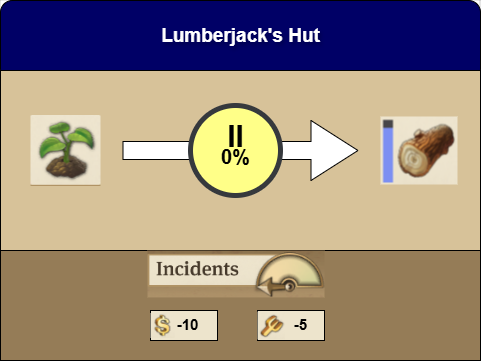
- Function: Harvests raw wood from nearby forested tiles.
- Placement: Needs undeveloped, wooded tiles in its radius. If none exist, it will plant trees—but this takes time.
- Production Rate: 1 ton of wood every 15 seconds (4 tons per minute).
- Efficiency Tip: To keep the Lumberjack’s Hut at 100% productivity, make sure at least 205 of the 240 tiles in its radius stay free of roads or buildings. Next, ensure you have enough farmers to keep the hut staffed. As a result, both placement and workforce become key factors. Finally, by managing space and labour together, you can keep the hut running at maximum efficiency.
Sawmill
The Sawmill takes the logs produced by the Lumberjack’s Hut and turns them into timber. To begin with, the Sawmill can be placed anywhere because no harvesting is required. Next, for maximum efficiency, place it close to both the Lumberjack’s Hut and the Warehouse. As a result, transport times are shorter, and productivity stays high. In turn, this setup keeps your timber supply steady and supports your city’s growth. In turn, this simple placement strategy ensures your timber supply stays steady and supports your city’s growth.
To build a Sawmill, you’ll need:
- $100 credits
- 2 timber planks
- 2×3 block of tiles
Besides the construction costs, running a Sawmill also requires ongoing resources:
- 10 farmers
- $10 credits per minute for maintenance.
Once these conditions are met, the Sawmill produces four tons of timber planks every minute. As a result, your production chains will always have a steady supply. Next, this consistency helps prevent bottlenecks and keeps pace with growing demand. Therefore, running the Sawmill efficiently is essential. In addition, a well‑managed sawmill supports both your city’s stability and its long‑term growth. Finally, it becomes a cornerstone of your economy and a key driver of expansion.
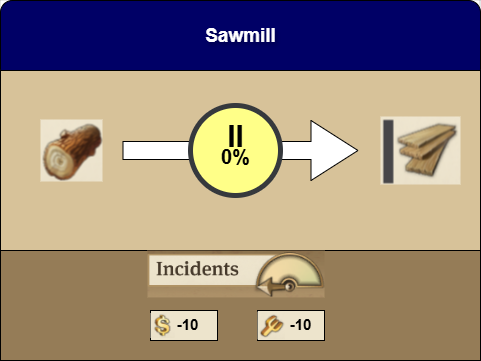
- Function: Converts wood into timber (planks).
- Placement: Should be close to a warehouse and/or Lumberjack’s Hut for optimal logistics.
- Production Rate: one ton of Timber every 15 seconds (four tons per minute).
- No Forest Requirement: Unlike the Lumberjack’s Hut, the Sawmill does not need nearby trees to operate. Instead, it is built only to process logs into Timber. As a result, this design streamlines the production chain. Finally, it makes Timber creation faster and more efficient.
Technology tree
This section outlines the technology tree for obtaining a Timber yard in Anno 1800. If your goal is to produce only wood, you should adjust your strategy by removing the Sawmill from the chain. First, both Lumberjack’s Huts and the Sawmill process wood at the same speed—one ton every 15 seconds. However, without the Sawmill, you will only receive logs instead of Timber. As a result, this setup keeps your resource output simpler. Next, by focusing only on logs, you can manage production more easily. Finally, this approach helps keep your network efficient.
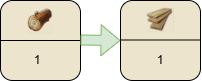
This is the standard technology tree for producing one ton of Timber every 15 seconds. In the following builds, you will see that we use more than one of each building. First, this setup allows production to scale beyond the basics. As a result, the network produces far more Timber than a single hut and Sawmill could provide. Next, by combining multiple huts with several Sawmills, the overall output rises steadily. Finally, this approach creates a stronger and more efficient timber supply for your city.
Layout
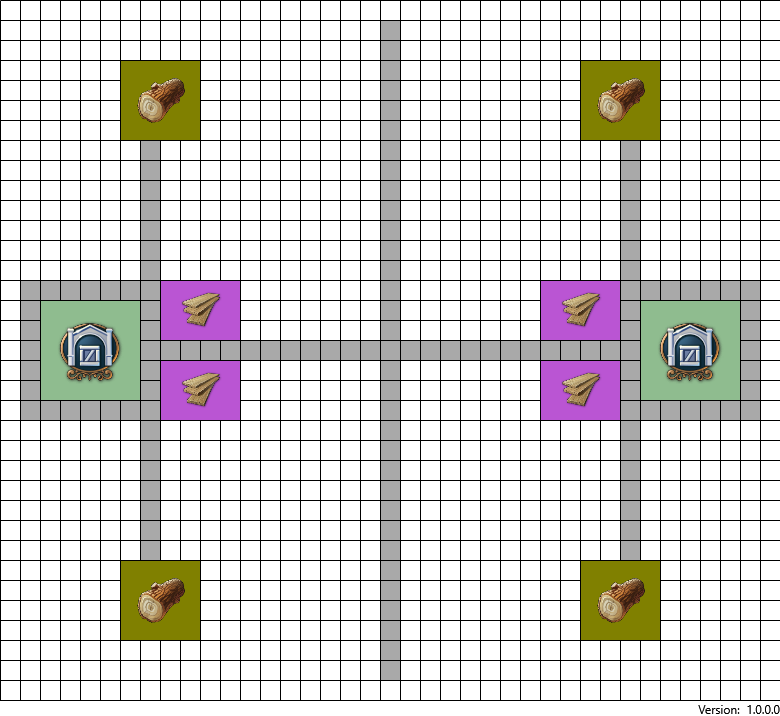
This is a perfect layout for a Timber yard in Anno 1800. From the central road create a road off of it by 10 blocks, at the end of this place a warehouse. Next place a road that goes 10 blocks either side and place a Lumberjacks hut on either side. Place down your Sawmills as shown in the picture above and repeat this on the other side of the road. This layout will produce 16 tons of Timber every minute.
Improving the productivity
On achieving workers you will find that you can now build a Trade union. Trade unions can be used for numerous things in Anno 1800. They boost productivity, buildings within the unions radius do not need roads to receive the benefit. As a building can only be affected by one Trade union at a time it is essential that you do not overlap in your design stage.
Here is a build that incorporates a trade union to give these benefits to the lumber yard.
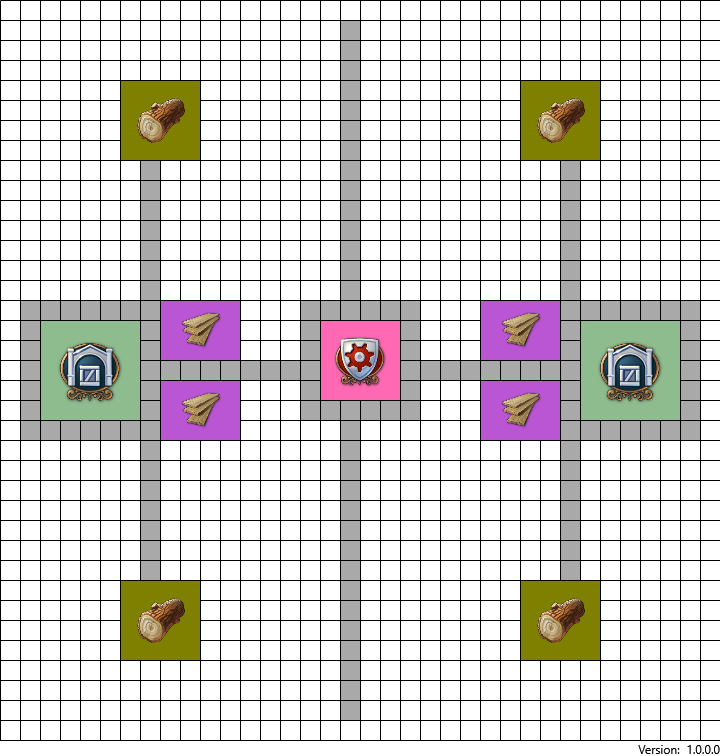
When using a Trade union, remember that it only works once cards are placed in the slots. First, without cards, the union provides no benefits. Next, keep in mind that most cards are designed for specific factories or farms. As a result, choosing the right ones is very important. Moreover, stronger card choices lead to better effects. Finally, by selecting carefully, you can boost productivity and make your Timber network much more efficient.
Trade cards for Lumberjack hut
This is a list of some of the best items for the Lumberjack hut:
| Item name | Effect | Rarity/Notes |
|---|---|---|
| Industrial thresher | +10% forest density, +40% productivity | Uncommon Expedition bonus – +10 crafting |
| Druids sickle | +30% productivity, +20% forest density | Rare Expedition bonus – +15 crafting |
| Teutonic Technical Secateurs | +40% productivity, +30% forest density | Epic Expedition bonus – +20 crafting |
| Aldea the forest warden | +3 attractiveness | Uncommon |
| Miss Rodriguez the conservationist | +40% productivity | Epic Expedition bonus – +40 crafting, +20 hunting |
| Vincent Drag saw | +50% productivity | Epic Expedition bonus – +20 crafting |
| Ursula Green Guardian of the forest | +50% productivity, +10% forest density | Legendary Expedition bonus – +45 crafting, +35 hunting, +25 navigation |
Trade cards for sawmill
This is a list of some of the best items for the Sawmill
| Item name | Effect | Rarity/Notes |
|---|---|---|
| Circular saw | +30% productivity, +30% chance of fire | Uncommon Expedition bonus – +20 crafting |
| Cabinet maker | +30% productivity, -60% workforce needed | Rare Expedition bonus – +35 crafting, +10 force |
| Circular rip saw | +40% productivity, +20% chance of fire | Rare Expedition bonus – +30 crafting |
| Harkers electric treadle lathe | +50% productivity, -25% workforce needed | Epic Expedition bonus – +40 crafting |
| Master craftsman Morris | -80% maintenance costs | Epic Expedition bonus – +45 crafting, +20 force |
| Seraphim Papadikas the Window dresser | +50% productivity | Legendary Expedition bonus – +55 crafting, +30 force |
Using electricity
Electricity does not improve Timber yard production. First, the output stays the same whether power is supplied or not. So, it is better to boost efficiency using trade unions or productivity cards. As a result, electricity should be reserved for industries that truly benefit from it. Finally, this approach keeps your resources focused where they matter most.