Bread in Anno 1800 is one of the most important goods. First, it satisfies the basic needs of Workers and Artisans, keeping your city stable. Next, it boosts expedition morale and provides extra rations, which makes tough journeys more manageable. Therefore, mastering bread production early on is essential for both steady growth and long-term resilience. With that in mind, let’s walk step by step through the chain. Bread is one of the most important goods in Anno 1800. Not only does it satisfy the basic needs of Workers and Artisans, but it also boosts morale during expeditions. Let’s walk step by step through the chain.
What is produced
Bakeries turn flour into Bread in Anno 1800. To begin with, bread is a crucial consumer good with many roles in the game. First of all, it meets the basic needs of Workers and Artisans. As a result, your population remains stable, and your city continues to grow. In addition, Bread proves useful during expeditions. For example, it raises morale by 20 points, provides extra rations, and adds a 5‑point bonus to the faith skill. Therefore, Bread is more than just a simple food, it becomes a valuable resource in tough situations. Ultimately, managing Bread production effectively ensures both short term stability and long term success for your empire.
Over time, Bread becomes even more important. On the one hand, it connects farming with the growing demand of your city. On the other hand, it supports exploration and expansion. As a result, mastering Bread production becomes a key factor in maintaining economic stability. In addition, a strong Bread supply ensures that your population thrives while your empire continues to grow. In the long run, this steady production also provides a powerful strategic advantage, helping your empire remain resilient and competitive.

Buildings in this chain
In Anno 1800, bread production showcases a dynamic multi-tiered supply chain. Grain farms grow the raw grain, Flour mills grind it into flour, and Bakeries bake the flour into Bread. Each step actively contributes to a streamlined production line that turns agricultural resources into a vital consumer good. The following breakdown guides you step by step through the bread making process. To begin with, it starts with grain, then moves on to flour, and finally ends with a finished loaf.
| Building | No. needed | Costs per building | Total Costs |
| Grain farm | 2 | $500 credits 4 timber -20 maintenance 20 farmers | $1,000 credits 8 timber -40 maintenance 40 farmers |
| Flour mill | 1 | $500 credits 4 timber 5 bricks -50 maintenance 10 farmers | $500 credits 4 timber 5 bricks -50 maintenance 10 farmers |
| Bakery | 2 | $1,000 credits 4 timber 5 bricks -60 maintenance 50 workers | $2,000 credits 8 timber 10 bricks -120 maintenance 100 workers |
| Warehouse | 1 | $500 credits 10 timber -20 maintenance | $500 credits 10 timber -20 maintenance |
| Total | $4,000 credits 30 timber 15 bricks -230 maintenance 50 farmers 100 workers |
The Grain Farm

In Anno 1800, the Grain Farm is one of the very first production buildings you will construct in the Old World. At first, the Grain Farm plays a key role in your early economy because it produces grain, an essential ingredient for both bread and beer. As your city begins to expand, and then as your population increases, grain quickly becomes even more important. Furthermore, it helps meet rising consumer demands. In addition, it supports several different production chains, which means the Grain Farm remains a critical asset throughout the entire game. For this reason, keeping grain production strong is vital. Ultimately, this steady supply ensures both short‑term stability and long‑term growth for your empire.
To build a Grain Farm, you’ll need:
- $500 credits
- 4 timber
- Grain fertility on the island
- 3×4 tile space plus 144 field tiles (placed manually)
In addition to the construction costs, running a Grain Farm also requires several ongoing resources.
- 20 farmers
- $20 credits per minute for maintenance
Once these conditions are met, the farm will begin producing one ton of grain every minute. As a result, you’ll have a steady supply to keep your production chains running smoothly. In turn, this consistency helps prevent shortages and ensures that your city continues to grow without interruption. Below is an image showing how to place the grain farm efficiently.
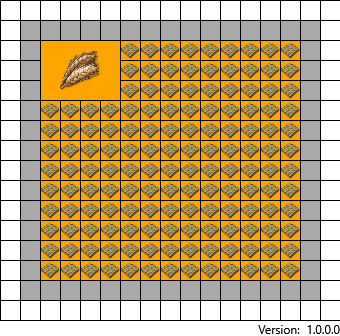
This is a layout for the single Grain farm, as you can see it is in a square making it easy to copy when you add more to it later in the game.
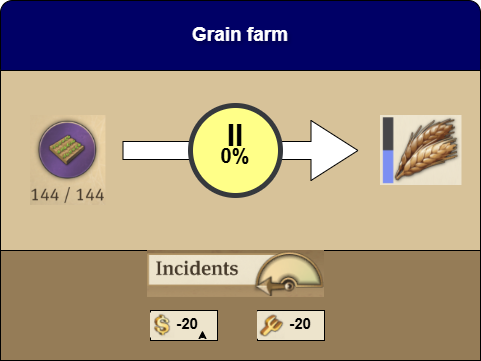
- Function – farm for growing wheat.
- Limitation – it must be placed on islands with grain fertility.
- Production rate – farm produces one ton of wheat every minute.
- Unlocks – at 150 workers.
- Regions – available in the Old World.
- Field requirements – needs 144 tiles.
The Flour Mill

The Flour Mill is a production building that transforms grain into flour. Once the flour is ready, it is sent to Bakeries, where it is turned into Bread in Anno 1800. As a result, Bread becomes a basic need for both Workers and Artisans. Because of this, the Flour Mill acts as a vital link in the food chain. In turn, it helps ensure that your population stays satisfied and your city continues to grow. Ultimately, the Flour Mill is not just another building, it is a cornerstone of your economy and long term stability.
To build a Flour Mill, you’ll need:
- $500 credits
- 4 timber
- 5 bricks
- 3×4 tile space
Besides the construction costs, running a Flour Mill also requires several ongoing resources:
- 10 farmers
- $50 credits per minute for maintenance
Once these conditions are met, the Flour Mill will reliably produce two tons of flour every minute. As a result, your production chains will always have a steady supply. In addition, this consistency helps prevent bottlenecks in bread production. Moreover, it ensures that Bakeries can keep pace with growing demand. For this reason, keeping the mill running efficiently is essential. At the same time, it strengthens the overall flow of your food chain. In the end, a well‑managed Flour Mill supports both your city’s stability and its long‑term growth. Ultimately, it becomes a cornerstone of your economy and a key driver of expansion.
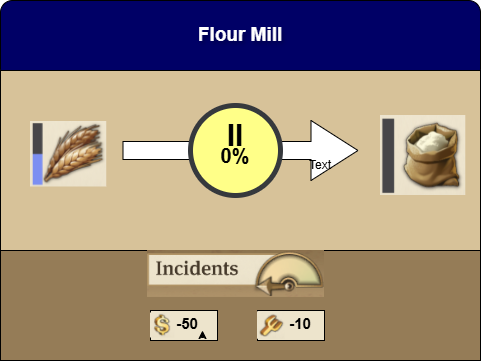
- Function – To turn grain into flour.
- Limitation – Needs to have grain in order to produce flour.
- Production rate – The mill produces one ton of flour every 30 seconds.
- Unlocks – at 150 workers.
- Regions – Available in the Old World.
- Area requirements – Needs a 3×4 space.
The Bakery

The Bakery is the building that turns flour into Bread in Anno 1800. To begin with, it represents the final step in the Bread chain, transforming grain products into a vital consumer good. As a result, Bread helps stabilize your population and keeps your city running smoothly. In addition, it plays an important role in expeditions by boosting morale and providing extra rations. Moreover, Bread can enhance tourism, making your city more attractive to visitors. For this reason, managing Bakeries efficiently is essential. Ultimately, well‑run Bakeries ensure both the growth and resilience of your empire.
To build a Bakery, you’ll need:
- $1,000 credits
- 4 timber
- 5 bricks
- 3×4 tile space
Besides the construction costs, running a Bakery also requires several ongoing resources:
- 50 workers
- $60 credits per minute for maintenance
Once these conditions are met, the Bakery will reliably produce one ton of bread every minute.
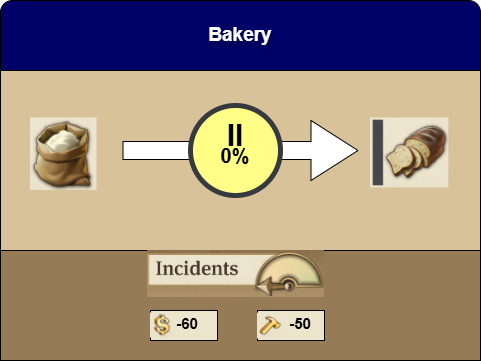
- Function – To turn flour into bread.
- Limitations – Needs to have grain in order to turn into flour.
- Production rate – The Bakery produces one ton of Bread per minute.
- Unlocks – At 150 workers.
- Regions – Available in the Old World.
- Area requirements – Needs a 3×4 space.
Technology Tree
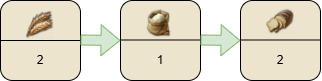
This is the tech tree for the Bread production chain. To begin with, you will need a Grain Farm to produce wheat. Then, that wheat is sent to the Flour Mill, where it is transformed into flour. After that, the flour is delivered to the Bakery. Once the Bakery receives the flour, it can finally produce bread for your population. As a result, your citizens’ basic needs are satisfied. Moreover, this steady supply of Bread ensures that your city continues to thrive. In the end, the Bread chain demonstrates how each building works together to support growth and stability.
Layout
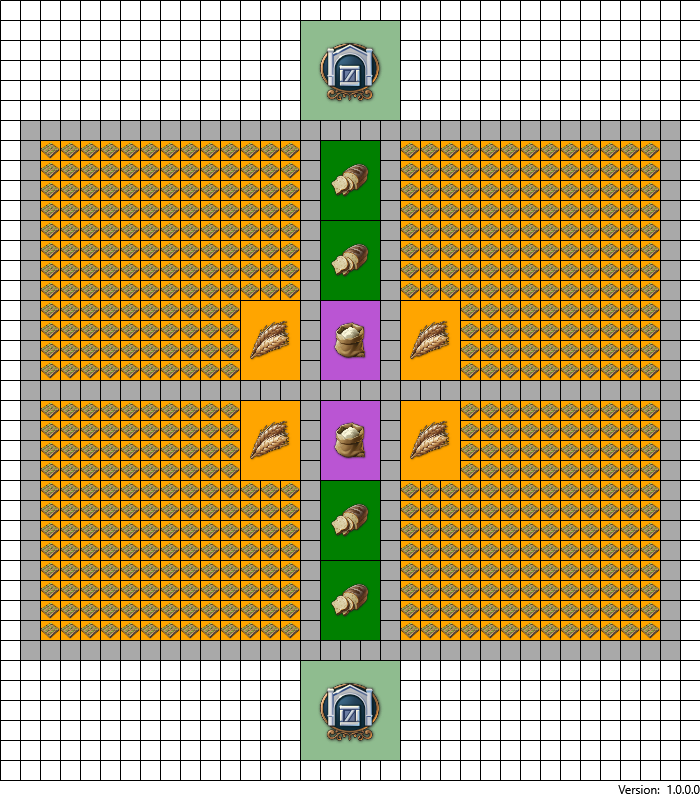
This is the basic layout for the production of Bread in Anno 1800. As we can see this is a more complicated build that requires four separate buildings just for the basic build. You will need to place two Grain farms, one Flour mill, and two Bakeries. This will enable you to produce one ton of bread every minute. Make sure that the buildings are placed as they are in the diagram as this ensures good productivity.
This diagram illustrates the layout for two production chains. At first, you will only need one chain to begin producing bread. However, as the game progresses, demand will rise, and you will require more than one chain to keep pace. Furthermore, having multiple chains guarantees a steady supply of Bread in Anno 1800. As a result, shortages are prevented, and your city continues to run smoothly. In the long run, expanding to two or more chains becomes essential, since it supports growth and ensures long term stability.
Improving productivity
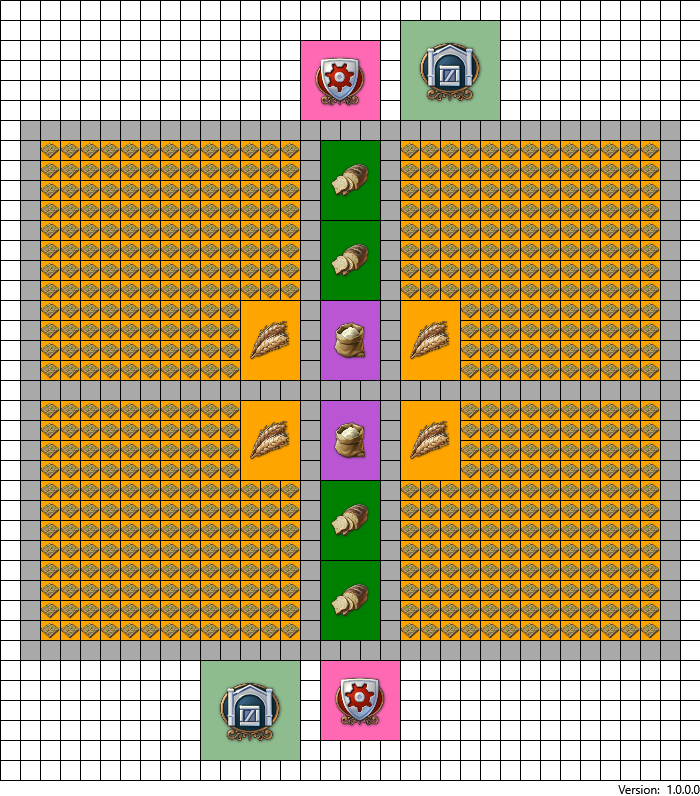
On achieving Workers you will find that you can now build a Trade union. Trade unions can be used for numerous things in Anno 1800. They boost productivity, buildings within the unions radius do not need roads to receive the benefit. As a building can only be affected by one Trade union at a time it is essential that you do not overlap in your design stage.
Each Trade union can hold three items. As a result, you will need to decide which ones to use for the greatest benefit. To begin with, consider items that boost productivity. In addition, look at options that reduce workforce or maintenance costs. Moreover, some items provide special bonuses that can strengthen your economy. For this reason, choosing wisely is essential. Ultimately, the right combination of items will maximize efficiency and give your city a strong advantage.
For this build you will need two Trade unions to cover all of the buildings in the layout. Please ensure that you follow the illustration carefully so that this happens.
Trade union items for the Grain farm
This is a list of some of the best items for the Grain farm.
| Item name | Effect | Rarity/Notes |
|---|---|---|
| Medal-winning Producer | +40% productivity | Rare |
| Alexander Hancock | +80% productivity, +35% more field modules | Epic |
| Agricultural Engineer | +60% productivity, -20% workforce needed | Legendary |
| Fertilizer Specialist | +50% productivity, -10% maintenance costs | Uncommon |
Trade union items for the Flour mill
This is a list of some of the best items for the Flour mill.
| Item name | Effect | Rarity/Notes |
|---|---|---|
| Burrstone | +35% productivity, -25% workforce needed | Rare |
| Lovelymans grinding machine | +40% productivity, -50% workforce needed | Epic |
| Millstone | +25% productivity | Uncommon |
| Old factory bell | +10% maintenance costs, -20% workforce needed | Uncommon |
Trade union items for the Bakery
This is a list of some of the best items for the Bakery.
| Item name | Effect | Rarity/Notes |
|---|---|---|
| Baker | Processes grain instead of flour (no need for the flour mill) | Common Expedition bonus- +10 crafting |
| Cast iron stove | +30% productivity, -20% chance of fire | Rare |
| Elmers electric oven | +40% productivity, -25% workforce needed, -30% chance of fire | Epic |
| Fine cake decorator | +30% productivity | Rare Expedition bonus- +30 crafting +10 faith |
| Marie-Antoine Pâtissier Royale | +50% Productivity, Occasionally produces chocolate or grapes | Legendary Expedition bonus- +50 crafting +20 diplomacy |
| Pâtissier Patrice | +40% productivity, +5 attractiveness | Epic Expedition bonus- +40 crafting +20 force |
| Pastry chef | -50% maintenance costs | Uncommon Expedition bonus- +20 crafting |
Using electricity
Grain farm
The Grain farm does not receive any benefit from obtaining electricity.
Flour mill
The Flour mill does not receive any benefit from obtaining electricity.
Bakery
Normally, the Bakery produces Bread at a steady rate. However, its production doubles when it receives electricity. As a result, your city gains a much larger supply of Bread. In addition, this boost helps meet rising demand more easily. Therefore, connecting bakeries to electricity is one of the most effective ways to strengthen your food chain. Ultimately, it ensures both efficiency and long term growth for your empire.