To begin with, producing Bricks in Anno 1800 is a simple but vital chain. It starts with a Clay Pit, which extracts clay from the ground. Next, the clay is sent to a Brick Factory, where it is transformed into Bricks. As a result, you gain one of the most important construction materials in the game. Finally, Bricks are used for roads, buildings, and upgrades, making them essential for expanding your city.
What is produced
In this production chain, you will be producing Bricks. First, Bricks become a core construction material once you reach the worker stage. Next, most buildings from the worker tier onward require bricks to build.
In addition, Bricks are used for paving roads. As a result, carts move faster, Trade Unions cover a wider area, and electricity can travel farther. However, Bricks provide no benefit for expeditions. Therefore, their true value lies in supporting city growth and strengthening infrastructure.

Buildings in this chain
Here, we will look at the costs and how the buildings in the Brick chain. First, the chain includes two buildings: a Clay Pit and a Brick Factory. The Clay Pit produces clay at a rate of one ton every 30 seconds. Next, the Brick Factory takes this clay and produces one ton of bricks every minute. For this reason, it is best to place two Brick Factories close to one Clay Pit to achieve maximum efficiency.
| Building | No. needed | Cost per building | Total cost |
|---|---|---|---|
| Clay pit | 1 | $250 credits, 4 timber, -10 maintenance, 50 farmers | $250 credits 4 timber -10 maintenance 50 farmers |
| Brick factory | 2 | $500 credits, 8 timber, -20 maintenance, 25 workers | $1000 credits 16 timber -40 maintenance 50 workers |
| Warehouse | 1 | $500 credits, 10 timber, -20 maintenance | $500 credits 10 timber -20 maintenance |
| Total | $1750 credits 30 timber -70 maintenance 50 farmers 50 workers |
Clay pit

To begin with, the Clay Pit is a building that becomes available once you reach the worker stage. In order to mine clay, your island must have clay deposits. Next, you will need to look around your island to locate these deposits. Once you find one, you can place a Clay Pit directly on top of it. As a result, the building will start extracting clay, which is the first step in brick production.
To build the Clay pit it will cost you:
- $250 credits
- 4 timber
In addition to the construction costs, you will also need to account for the following ongoing costs.
- 50 Farmers
- -10 credits per minute in maintenance
Once these conditions are met, the Clay Pit will reliably produce two tons of Clay per minute. As a result, you will have a steady supply of Clay to support your population’s construction needs. In addition, this steady output ensures that your Brick Factories always have enough raw material to keep production running smoothly.
Moreover, a reliable Clay supply is essential for expanding your islands. Because bricks are needed for roads, buildings, and upgrades, the Clay Pit plays a crucial role in city growth and infrastructure. Therefore, placing Clay Pits strategically and balancing them with enough Brick Factories is the key to maintaining efficiency and avoiding shortages.
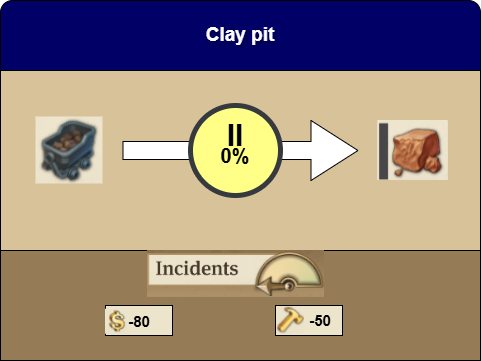
- Function – to extract clay from a clay pit.
- Placement – needs to be placed on top of a clay pit.
- Production rate – produces one ton of clay every 30 seconds.
- Limitation – Can only be paced on clay deposits.
- Regions – Old World, New World and Cape Trelawney.
- Unlocks – unlocks at one worker.
- Depletion – the clay deposit does not deplete.
Brick factory

The Brick factory is a building that you can build once you get to worker level in the game. The brick factory will take clay from the clay mine and process bricks with it.
To build the Brick factory it will cost:
- $500 credits
- 8 timber
As well as the construction costs, you will also need the following ongoing costs:
- 25 workers
- -20 credit per minute maintenance
Once these conditions are met, the Brick Factory will reliably produce one ton of bricks per minute. As a result, you will have a steady supply of Bricks to support all your construction needs.
In addition, this steady output ensures your city can grow without delays. Because Bricks in Anno 1800, are required for most Worker tier buildings and for upgrading roads, keeping a reliable supply is essential for expansion. Moreover, paved roads made with Bricks improve cart speed, extend the range of Trade Unions, and allow electricity to travel farther across your city.
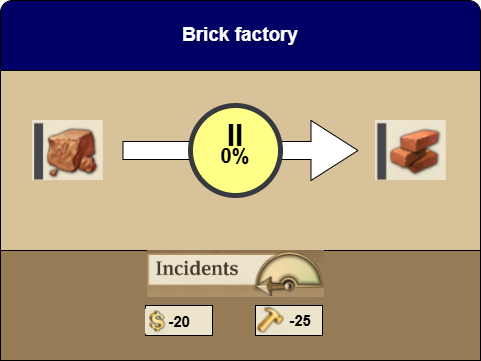
- Function – used to turn clay into bricks.
- Placement – best placed by the clay mine for efficient production.
- Production rate – produces one ton of bricks per minute.
- Regions – Old World, New World and Cape Trelawney.
- Unlocks – unlocks at one worker.
Tech tree
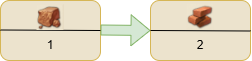
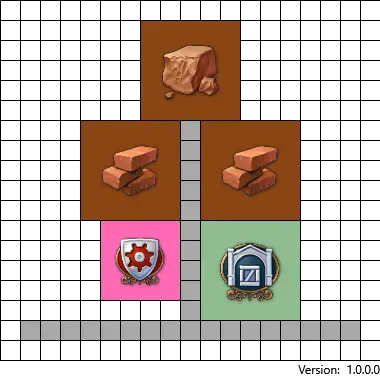
This is the tech tree for producing Bricks in Anno 1800. To begin with, it is important to balance your Clay Pits and Brick Factories. For this reason, you should place two Brick Factories near one Clay Pit. As a result, the clay output will be fully processed, since the Clay Pit produces enough clay to keep both factories running at full capacity. Therefore, careful planning of your brick chain will prevent shortages and keep your city’s infrastructure strong.
Layout
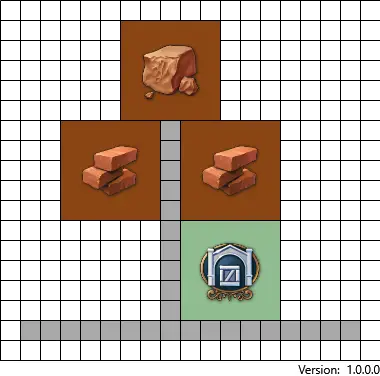
This is the basic layout for producing bricks in Anno 1800. To begin with, the entire chain must be placed near a clay deposit so you can build a Clay Pit. Next, the Clay Pit will supply clay directly to two Brick Factories. After that, the bricks are sent to a Warehouse for storage and distribution.
By arranging the buildings this way, you ensure maximum productivity. For this reason, one Clay Pit should always be paired with two Brick Factories. As a result, the clay output is fully processed without waste. In turn, this setup provides your city with a steady supply of bricks. Therefore, you can reliably support construction projects and continue expanding your settlements.
Improving the productivity
Once you reach the worker stage, you unlock the ability to build Trade Unions. From this point onward, Trade Unions can be used for many purposes in Anno 1800. Most importantly, they boost productivity for the buildings within their radius. In addition, those buildings do not need roads to receive the benefit.
However, it is important to note that each building can only be affected by one Trade Union at a time. For this reason, you should avoid overlapping their coverage when designing your layout. Therefore, careful placement of Trade Unions is essential to maximize efficiency and keep your city running smoothly.
Here, we can see that a Trade Union has been placed in the layout. As a result, the nearby buildings receive productivity bonuses and other benefits.
Trade union items for Clay pit
Here are some of the best items for the Clay pit.
| Item name | Effect | Rarity/Notes |
|---|---|---|
| Digger | +10% productivity | Common Expedition bonus – +15 crafting +5 force |
| Drill | +25% productivity, +25% maintenance costs | Uncommon Expedition bonus – +15 crafting |
| Quarryman | -100% workforce needed | Uncommon Expedition bonus – +10 crafting +10 force |
| Mechanical Drill | +35% productivity, +15% maintenance costs | Rare Expedition costs – +25 crafting |
| Quarry Foreman | +30% productivity, -50% maintenance costs | Rare Expedition costs – +15 crafting +15 force |
| Fine Handheld Power Auger | +40% production, -20% workforce needed | Epic Expedition bonus – +35 crafting |
| Steven Macleod, Geological Surveyor | +50% productivity, Occasionally produces pearls and gold ore | Legendary Expedition bonus – +25 crafting +25 diplomacy +25 force |
Trade union items for the Brick factory
Here are some of the best items for the Brick factory.
| Item name | Effect | Rarity/Notes |
|---|---|---|
Moulder | +10% productivity | Common Expedition bonus – +10 crafting |
Brickmaker | -100 maintenance costs | Uncommon Expedition bonus – +20 crafting |
Wooden Moulds | +25% productivity | Uncommon Expedition bonus – +10 crafting |
General Foreman | -60% workforce needed | Rare Expedition bonus – +30 crafting +5 force |
| Steel Moulds | +35% productivity | Rare Expedition bonus – +15 crafting |
| Ferhat the Experienced Builder | +40% productivity, Provides electricity | Epic Expedition bonus – +40 crafting +10 force |
| Francois Thorne, The Industrial Enforcer | +50% productivity, +8 attractiveness, substitutes workers for farmers | Legendary Expedition bonus – +50 crafting +15 force |
Using electricity
Clay pit
Unlike the Brick Factory, the Clay Pit does not receive any benefit from electricity. As a result, its production rate remains the same even when connected to a power supply. Therefore, electricity should be prioritized for buildings like the Brick Factory, where it directly boosts efficiency.
Brick factory
When electricity is supplied to the Brick Factory, its production rate doubles. As a result, the factory produces twice the amount of bricks compared to before. For example, if you were receiving one ton of bricks per minute, after adding electricity you will now receive two tons per minute. Therefore, connecting your Brick Factory to electricity is an effective way to boost efficiency and ensure a steady supply of construction materials.