Work Clothes in Anno 1800 are one of the earliest and most critical production chains in Anno 1800. To begin with, keep a steady 1:1 ratio of Sheep Farms to Framework Knitters. Next, as your city grows, boost their efficiency with Trade Unions, and later on, enhance productivity even further by supplying electricity. Finally, always prioritize Work Clothes production to maintain a stable workforce.
What is produced
Work Clothes in Anno 1800 are one of the earliest and most essential needs for your farmers and workers. To begin with, they ensure that your population remains stable. Without them, your Farmers and Workers will quickly lose satisfaction, and their numbers will start to decline. As a result, maintaining a steady supply of Work Clothes is critical for keeping your city growing.
Moreover, Work Clothes are not only vital for everyday life but also play an important role in expeditions. For example, carrying 50 tons of Work Clothes provides a +20 morale bonus and a +20 medicine bonus. Therefore, stocking up on them before sending ships on long journeys can significantly improve your chances of success.
In summary, Work Clothes serve a dual purpose: they sustain your workforce at home and strengthen your expeditions abroad. By prioritizing their production, you secure both the stability of your city and the resilience of your ventures.

Buildings in this chain
The Work Clothes production showcases a dynamic multi-tiered supply chain. First, Sheep Farms produce the wool then, Framework Knitters transform that wool into Work Clothes. As a result, each step actively contributes to a streamlined production line that turns agricultural resources into a vital consumer good. Next, the following breakdown guides you step by step through the Work Clothes process. Ultimately, it begins with wool and concludes with finished work clothes.
| Building | No. needed | Total costs |
|---|---|---|
| Sheep Farm | 1 | $100 credits 2 timber planks -10 maintenance 10 farmers |
| Framework knitter | 1 | $100 credits 2 timber planks -50 maintenance 10 farmers |
| Warehouse | 1 | $500 credits 10 timber planks -20 maintenance |
| Total | $700 credits 14 timber planks -80 maintenance 20 farmers |
Sheep farm

In Anno 1800, the Sheep Farm is an early game production building that produces Wool, which is then processed into Work Clothes. It unlocks at the Farmer tier and is one of the first industries you must establish.
To build the Sheep Farm, you will need:
- $100 credits
- 2 timber
- 3×3 tile space for the building plus three 3×3 tile space for the sheep pens.
In addition to the above you will also need the following ongoing costs:
- 10 farmers
- $10 credits per minute maintenance
Once these conditions are met, the Sheep Farm will reliably produce two tons of wool every minute. As a result, you will have a steady supply for your production chains. Finally, this consistency helps keep your city growing without interruption. Below is an image of how to place the farm efficiently.
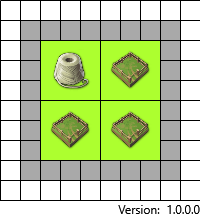
This layout shows a single Sheep Farm arranged in a square, making it simple to copy when you want to add more later in the game.
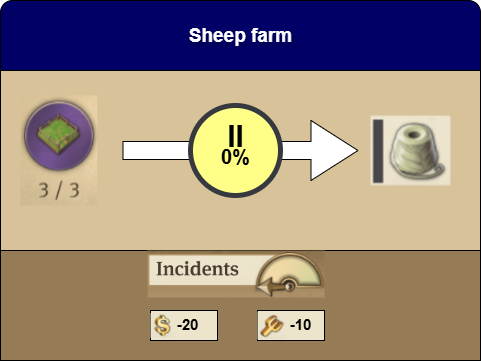
- Function: Used to house sheep and then to produce wool.
- Placement: Can be placed any where as a Sheep Farm contains it own pasture for the sheep.
- Production Rate: one ton of wool every 30 seconds so two tons every minute.
- Efficiency Tip: Ensure that you fully allocate the pastures for the sheep.
- Expeditions : wool will give you a morale bonus of +20 and a crafting skill bonus of +10 for 50 tons.
Framework knitters
Here’s a clear overview of Framework Knitters in Anno 1800 — the second step in the Work Clothes chain.
To build the framework knitters you will need:
- $100 credits
- 2 timber
- 3×3 tile space
As well as the above you will also need the following ongoing costs:
- 10 farmers
- $50 credits per minute maintenance
Once the above conditions are met the Framework Knitters will reliably produce two tons of Work Clothes per minute. As a result your production chain should have a steady supply.
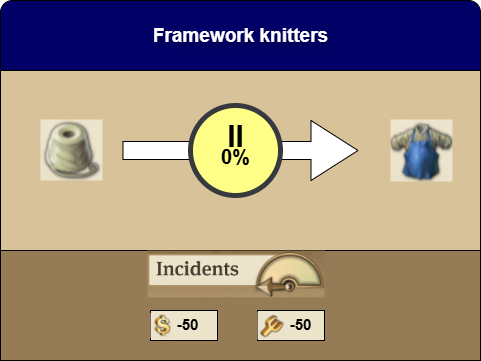
- Function: Converts wool into work clothes.
- Placement: Can be placed anywhere but remember to place by a warehouse and sheep farm.
- Production Rate: one ton of work clothes every 30 seconds (two tons per minute).
- Efficiency tip: Add a trade union close by with appropriate cards to increase efficiency.
Technology tree
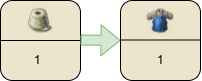
This is the technology tree for obtaining work clothes. The Sheep Farm and the Framework Knitters each produce at 1 ton every 30 seconds. This means that 2 tons of work clothes will be produced every minute. Ensure that these buildings are placed accordingly to maximise output.
Layout
This is a layout for the production of Work Clothes in Anno 1800. Here we can see the layout flowing from the Sheep Farm to the Framework Knitters and then finally onto the Warehouse. The placement of these buildings is key as this will cut down on the distance travelled for each of the buildings. This is key when designing your layouts to cut down on the travelling distance.

Improving the productivity.
On achieving workers you will find that you can now build a Trade union. Trade unions can be used for numerous things in Anno 1800. They boost productivity, buildings within the unions radius and do not need roads to receive the benefit. As a building can only be affected by one trade union at a time it is essential that you do not overlap in your design stage.
Here is a build that incorporates a Trade union to give these benefits to the work clothes production. When applying cards to this layout ensure that the Sheep Farms are applied faster, this will mean that later you can place a sailmaker in this build because their will be an overage of wool that can be utilised by the sail maker.
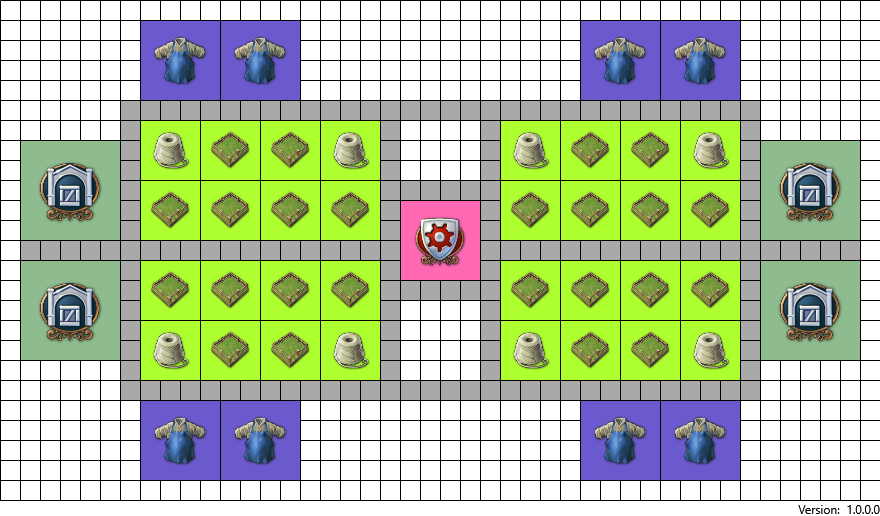
Here we see the work clothes build that incorporates a Trade union. The Trade union placed in the centre will ensure that all of these buildings will benefit from the Trade union.
Trade union cards for sheep farm.
| Item name | Effect | Rarity/Notes |
|---|---|---|
| Weaver | +10% productivity | Common Expedition bonus – +5 crafting |
| Feed yard | + 70% productivity +50% maintenance costs | Uncommon |
| Livestock Farmer | +30% productivity -60% workforce needed | Rare Expedition bonus – +30 hunting +10 medicine |
| A Remedy | +40% productivity | Epic Expedition bonus – +40 medicine |
| Mark van der Mark, Breeder of Shepherd Dogs | +100% productivity +100% extra modules | Legendary Expedition bonus – +30 diplomacy +50 hunting |
Trade union cards for Framework Knitters.
| Item name | Effect | Rarity/Notes |
|---|---|---|
| Lily the designer | +50% productivity, -25% work force | Great early game efficiency |
| Lady smythe | +40% productivity, +20% attractiveness | Ideal for beauty focused city |
| Clothes moth | +30% productivity, reduces fire risk | Good mid-tier boost with safety benefits |
| Hopedale loom shuttle | +60% productivity, replenishes when empty | Legendary item – massive boost |
| Feras the hypnotist | +40% productivity, improves happiness | Useful in morale sensitive layouts |
| Engineers gift | +35% productivity, -10% maintenance | Balanced boost with economic savings |
Using electricity
Sheep farm
Sheep farms gain no benefit from electricity. However, once you supply electricity to the Framework Knitters, their output doubles. As a result, they will consume twice as much wool. Therefore, you must increase the number of Sheep Farms to keep pace with demand. In this way, your production chain stays balanced and efficient.
Framework knitters
When the Framework Knitters receive electricity, their productivity doubles, increasing output by 100%. As a result, you must expand your supply chain to keep pace. Therefore, make sure you build enough Sheep Farms to provide the extra wool required. In this way, your Framework Knitters will continue running at full efficiency without interruptions.