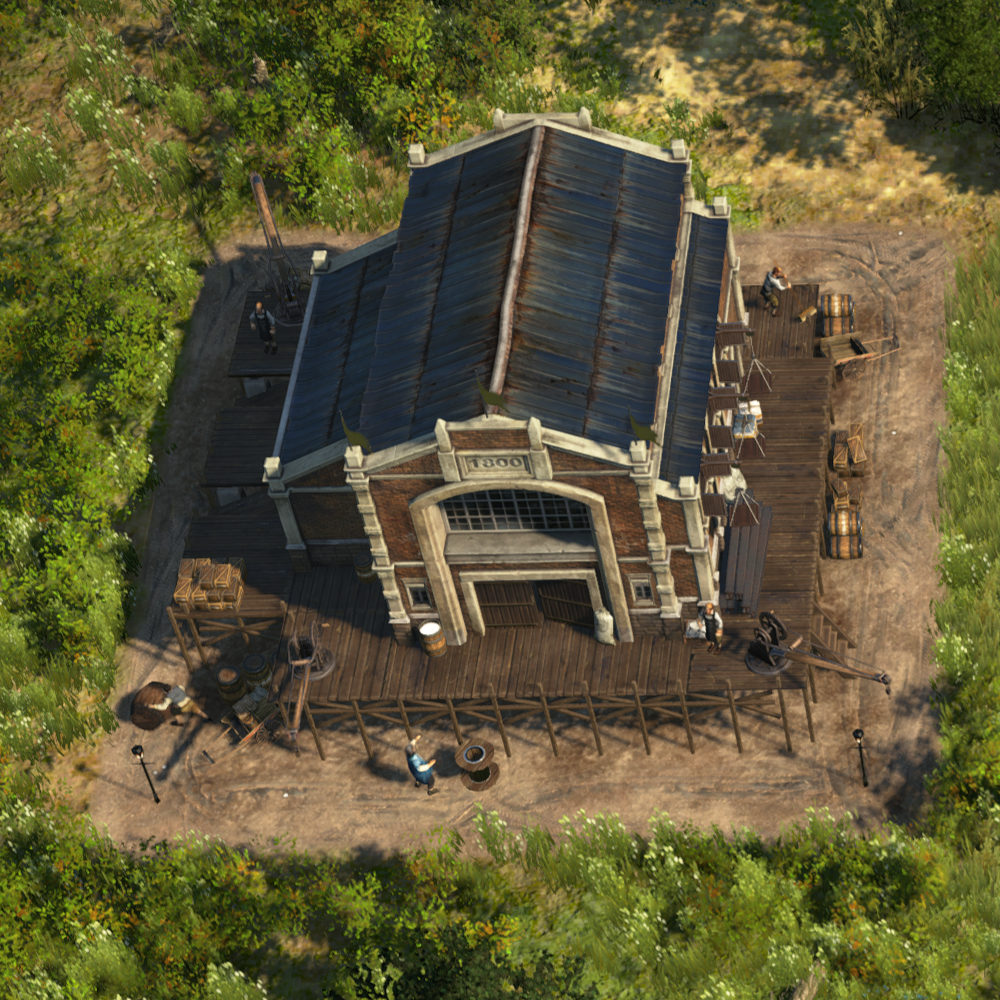
To build
- $500 credits
- 10 timber
Details
- Area 5×5
- -$20 credits maintenance
- Available in all regions.
This is the warehouse in Anno 1800. The warehouse is used to receive goods form your farms and industrial buildings.
Description
The warehouse is an essential building in Anno 1800. This is the place that all of your goods will be sent to from your farms, factories and other production buildings. Warehouses should be placed strategically close to the final production lines. This will ensure that the layouts that you are using are super efficient and get the product out to the people/buildings at the fastest rate possible. Warehouses need to be connected to the harbour at all times. The only exception is if you are making a link up of warehouses. This means a warehouse can be linked to another warehouse that is linked to the harbour without its own separate road. The warehouse has got three upgrade options that will increase the number of loading bays for your carts.
Improvements
In this section we will look at the improvements that you can do to the warehouse. The warehouse is one of the buildings where placement improves massively the function of the warehouse.
Placement
The placement of the warehouse in Anno 1800 is key to improving its efficiency. As with all buildings in Anno 1800 production chains the warehouse placement, it is key that you place it at the end of the chain. The goods will then flow through to the warehouse with minimal transport time. This will speed up the process and also use less slots at the warehouse.

This shows the layout for the working clothes production chain. When we look at it we can see that the framework knitters are placed directly across from the sheep farm. This means that there is minimal travel time between these two buildings and the wool will go directly to the framework knitters and not into the warehouse first. Once the framework knitters have created work clothes these will then be transported to the warehouse and be available for you to use. This is key as it will cut down on the number of slots the warehouse uses.
Warehouse upgrades
Warehouses can be upgraded from their starting point which is a small warehouse up to a much larger Grand Warehouse. When upgrading warehouses it is important to remember that it will be cheaper to build a new warehouse than upgrade a current one. The reason to upgrade a warehouse instead of building a new one are mainly because of space available. If you do not have enough space for a new warehouse you then need to upgrade. The upgrades are as follows.
| Warehouse size | Loading ramps | Old world cost | New world cost |
|---|---|---|---|
| Small | 2 loading ramps | $500 10 timber | $500 10 timber |
| Medium | +1 loading ramp | $2500 20 timber 20 bricks | $2500 20 timber 20 bricks |
| Large | +1 loading ramp | $10000 30 timber 30 bricks 20 beams 20 windows | $10000 30 timber 30 bricks 20 beams |
| Grand | +2 loading ramps | $100000 75 timber 75 bricks 50beams 50 windows 15 concrete | None available |
These are the building costs in both the old world and the new world.
When we look at the costs of building larger warehouses it can be much cheaper to plan the layouts and production chains so that they contain a warehouse. This will mean that you will probably not have to upgrade the warehouses to far as they will be used per production chain.
Layouts
These are the layouts for the warehouse. When dealing with layouts for the warehouse we will be looking at the production chains that are used. The warehouse will be included in all the production chains on this website.
Option 1
In this layout we will be showing the production chain for timber. The Timber Production Chain is quite large in area as the Lumberjacks hut needs space to grow trees for the Sawmill.

Here we can see the Timber Production Chain. The warehouse is placed in the middle of the chain, this means that the carts carrying the finished Timber to the warehouse have the shortest distance to travel. The Timber will then be available as soon as possible.