Here we will be looking at Caoutchouc in Anno 1800. Caoutchouc is a Plant Product that can only be produced in the New World. It is produced at the Caoutchouc Plantation at the rate of one ton per minute. You will need to ensure that the island has the Caoutchouc fertility.
Trading Caoutchouc
In this section we will be looking at Trading Caoutchouc in Anno 1800.
| Trading Type | Buying/Selling Type | Where from |
|---|---|---|
| Passive Selling | $20 Credits per ton | Traders to you harbour |
| Passive Buying | $50 Credits per ton | Traders to your harbour |
| Active Buying | $50 Credits per ton | Buy from Old Nate |
When we look at this table we can see that when a trader comes to your harbour and purchases Caoutchouc from you they will pay you $20 Credits per ton. On the other hand when a trader comes to your harbour and sells you Caoutchouc you will have to pay $50 Credits per ton. As you can see from the final row of the table you can also buy from Old Nate. You will be able to buy it for $50 credits per ton.
How to set up trading
As we can see from the table above there are two options for trading Caoutchouc. These are passive trading and also active trading. You will notice that there are two options for passive trading and also one option for active trading. Lets take a look at these options now.
Passive trading
Passive trading is where a trader comes to your Trade post and trades with you. To allow passive trading to work you will first have to set it up. The first thing that you will need to do is to select your Trade post on your island and you will be faced with a screen where you can select the item for trading. Once you have selected the item a new menu will open up that will show a screen showing a menu with a slider on it. Move this slider to set the minimum amount of stock to hold on this island. You will also notice that there are four buttons on this screen for the type of trade to do.
 |  |
 |  |
These are the buttons that you will be faced with on the trade type menu. They are No Trade, Buy and Sell, Sell or Buy. You can select these depending on what you wish to do for trade at this island. Once you have set these up traders will then trade with your island.
Active trading
As we can see the bottom two options on this table are for active trading. Active trading is where you will manually trade with NPC’s islands. There are two ways to carry out manual trading. The first one is to select one of your ships and then select the harbour that you wish it to go to. When the ship arrives you can then select the Trade post that you wish to trade with. Once you do this you will be faced with this screen.
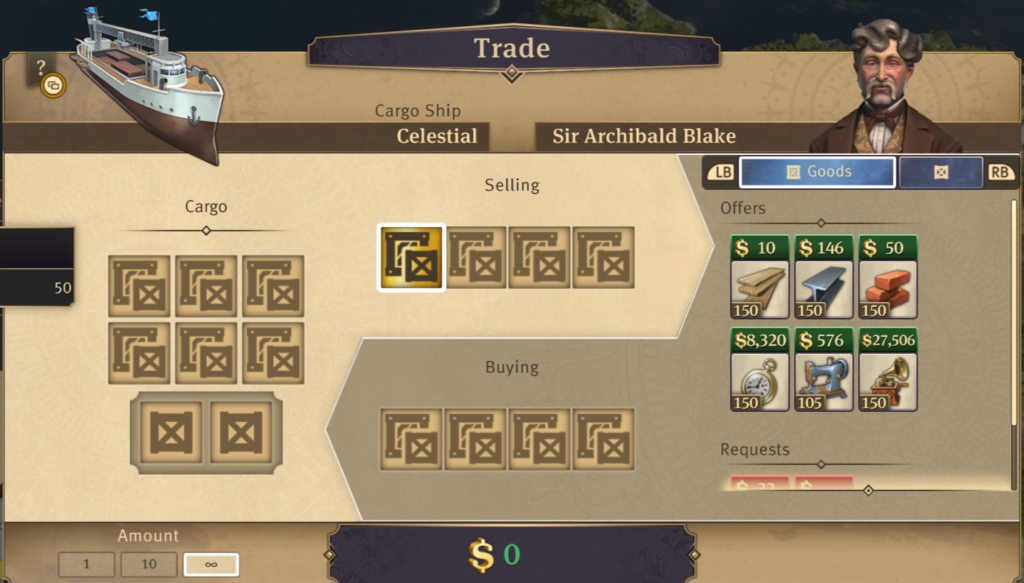
Here we can see that on the left is our ship and on the right is Sir Archibald Blake’s island. To trade here all you have to do is select the goods on the right hand side and they will then go to the bottom centre section buying. The cost will also be displayed at the bottom. When the goods have been selected you can then trade them on to your ship. You can then send the ship back to one of your islands and transfer the goods from your ship.
The next way to active trade is to set up a trade route. Lets take a look at this now. When setting up a trade route you will first need to select a ship that you wish to go on to the trade route. When you select the ship you will need to locate the button that is two arrows in a circle. This will then open up the trade screen where you can select the islands that you wish your ship to move between. Once you have selected these you will then move on to the screen to set up the trade.
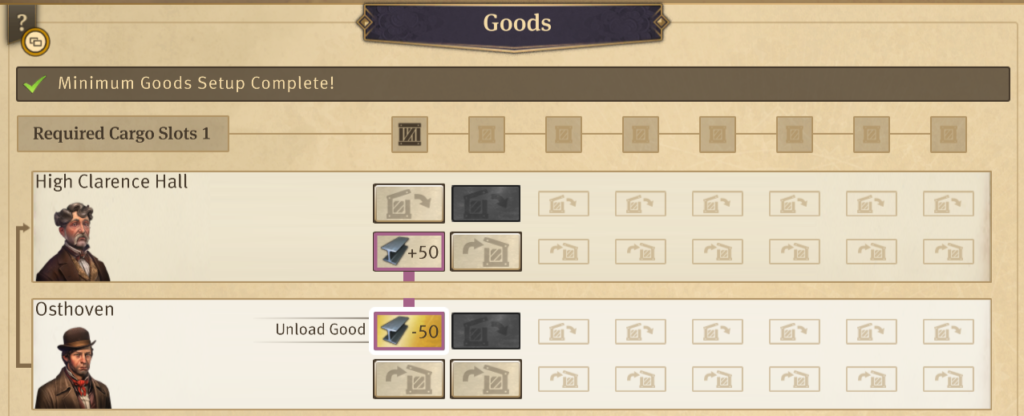
As we can see from the screenshot above we will load fifty tons of Steel Beams on to the ship whenever the ship arrives at High Clarence Hall. The ship will then move to Osthoven to unload. The ship will continue on this trade route until you cancel it.
Taking Caoutchouc on Expeditions
Their are many items in Anno 1800 that can be taken on Expeditions. When taking items on Expeditions they can give you benefits depending on what you take. Taking Caoutchouc on Expeditions will give you some of these benefits. These are 30 bonus points to Crafting Skill and also 50 bonus points to Morale for every 50 tons taken.
Product that are made using Caoutchouc
In this section we will look at what items are made using Caoutchouc. These items are
Penny Farthings
This is the Penny Farthings Production Chain in Anno 1800.
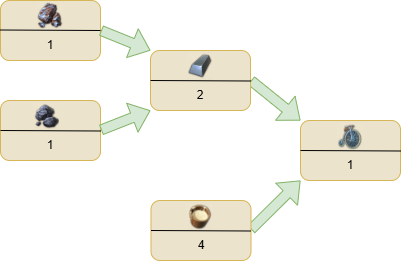
As we can see form this layout the first buildings that you will require are both an Iron Mine and a Coal Mine. The Iron and the Coal that is produced will then go to the Furnace for the production of Steel. This Steel will then go to the Bicycle Factory. The next buildings that we require will four Caoutchouc Plantations. These can only be built in the New World and will have to be transported back to the Old World to the Bicycle Factory. This layout will produce four tons of Penny Farthings per minute.
Steam Carriages
This is the Steam Carriages Production Chain in Anno 1800.
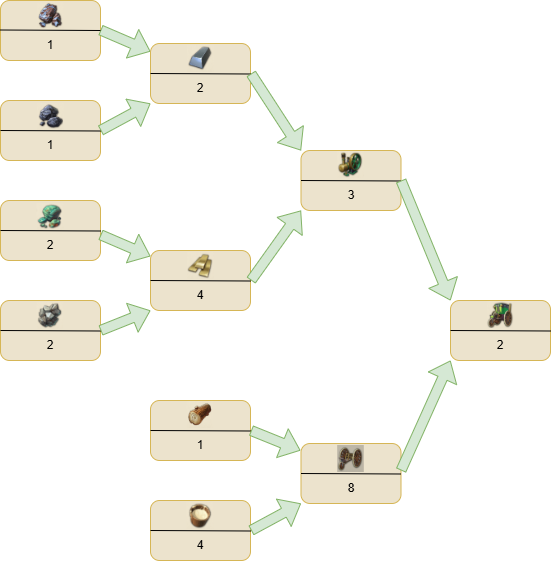
This is the Steam Carriages Production Chain in Anno 1800. As we can see this is a very complicated layout that requires buildings in both the Old World and the New World. So lets take this a step at a time.
The first step is to place down an Iron Mine and a Coal Mine. These mines will produce Coal and Iron that will go to the Furnace that will produce Steel for the Motor Assembly Line for the production of Steam Motors. For the production of Steam Motors, the Motor Assembly Line will also require Brass. This is obtained by two Copper Mines and two Zinc Mines that will supply the Brass Smeltery. The Brass Smeltery will then produce the Brass for the Motor Assembly Line.
Once the Motor Assembly Line has these items it will then send the Steam Motors to the Cab Assembly Line. On the bottom half of the layout we can see that we require Wood from a Lumberjacks Hut and also Caoutchouc from a Caoutchouc Plantation that can only be placed in the New World. This means that the Caoutchouc will have to transported from the New World to the Old World. Once you have this it will go to the Coachmakers for the production of Chassis that will then go to the Cab Assembly Line for the final production of Steam Carriages. This layout will produce four tons of Steam Carriages per minute.